

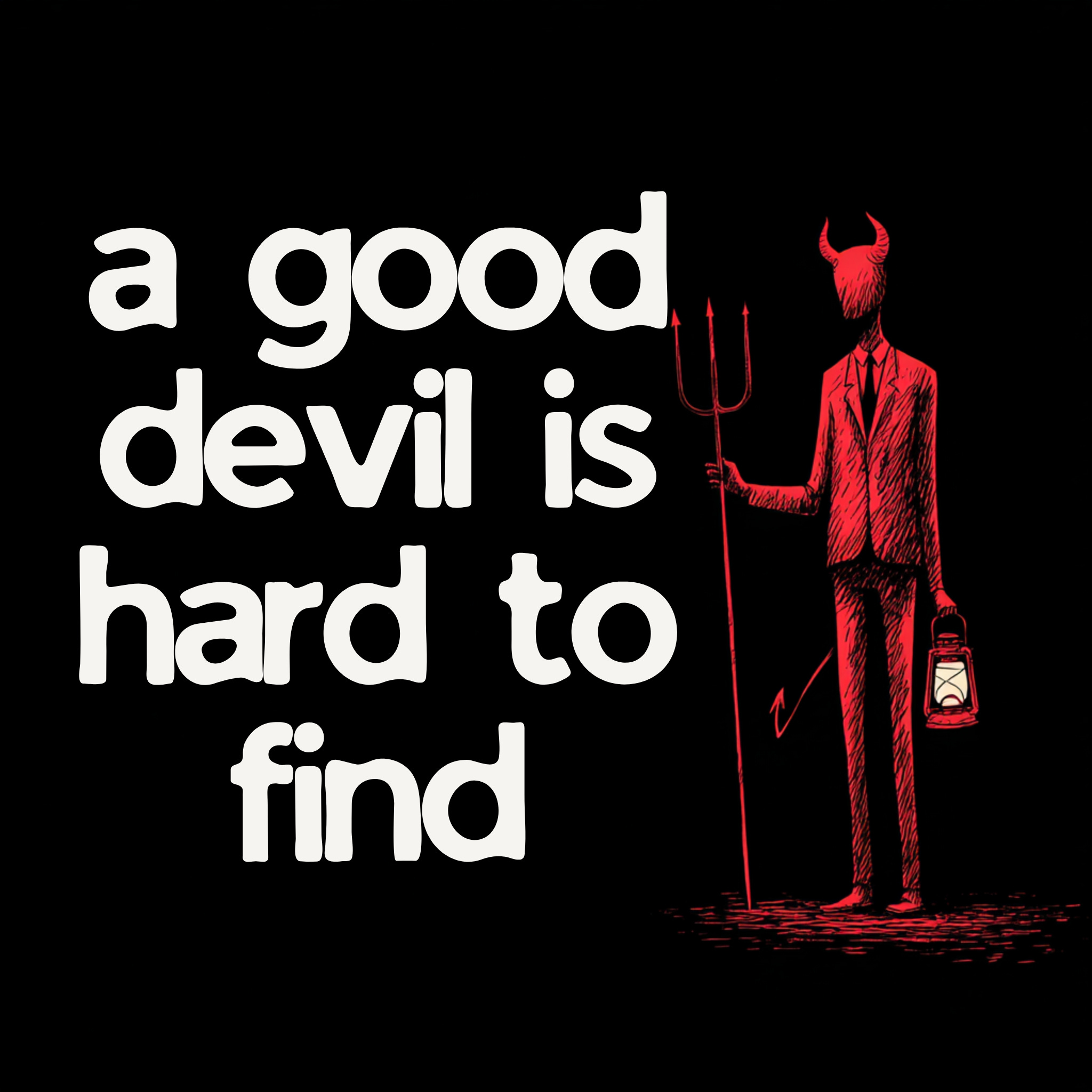
When my oldest daughter was five, like any God-fearing father, I attempted to lay out a basic theological foundation for her. I wasn’t covering the Council of Nicaea or anything. Just the basics because, as she was starting to pick up on some notions of Christianity at church, I thought it would be helpful to provide a Cliff’s Notes version of the theology she was absorbing.
To say it was generalized is an understatement. To say it was nuanced is an outright lie. But she was five. I kept it simple and aimed for the billboard aspects of Christianity.
I explained sin by pointing to her habit of slapping her older brother any time he got in her way. Also, the muttered “big doopies1” she used for Ashley and me whenever we made decisions she didn’t agree with.
For God and Jesus, I called them the good guys and skipped the trinity entirely. The trinity gets more confusing the more you try to explain it; the holy ghost in particular tends to derail the conversation. Instead, I made a vague comparison to Mickey Mouse and Toodles from Mickey Mouse Clubhouse, though I didn’t specify which one was God and which one was Jesus, and she didn’t ask. In truth, Mickey comes across more as a Jesus figure, whereas Toodles seems more akin to the Holy Spirit, but luckily, she didn’t seem interested in drilling down on the specificities of my analogy.
And as we all know, if we identify the good guys, we also have to identify the bad guy, which I did when I filled her in on Satan. It was here where I erred semantically, given that I gave Satan an AKA in the form of “the Devil.”
ME: …and the bad guy that we should avoid is Satan, or the Devil.
DAUGHTER: There are two bad guys to avoid?
ME: No, just one. He just has different names.
DAUGHTER: The more names you have, do that mean you are more bad?
ME: Not really.
(he pauses before continuing, not able to leave well enough alone.)
Unless you assassinate a President or something. They always seem to have three names.
DAUGHTER: What do “ass ass in eight” mean?
In retrospect, I should have held back on the AKAs. But she integrated the knowledge seamlessly once I explained that “Satan and “the Devil” were the same entity, a lot like “Clifford” and “the Big Red Dog.” Unfortunately, the appositive stuck and from that point on, she referred to him exclusively as “SayTAN the Debil,” her five-year-old syllabic emphasis colliding with a limited capacity for the letter V.
This wouldn’t have mattered if Satan, the Devil, hadn’t started coming up constantly. Once I’d described his appearance, his vibe, and the thumbnail on his theological deal (steal, kill, destroy, etc.), her curiosity was activated.
(In the car listening to a Taylor Swift song)
DAUGHTER: (singing along to Shake It Off, then pausing) Do Taylor Swift know SayTAN the Debil?
ME: I don’t think so. But, there are some people on the internet who might think she does.
DAUGHTER: (gasps) Wait! Do she really know SayTAN the Debil?
ME: I mean, she is extremely rich, famous, and successful.
DAUGHTER: Do all rich, famous, and suckfesful people know SayTAN the Debil?
ME: It’s possible.
DAUGHTER: That good for you then.
ME: Ha, yeah, thanks.
DAUGHTER: (gilding the lily) Because you are NOT rich, famous, or suckfesful!
ME: Right, thanks for clarifying that.
DAUGHTER: You welcome.
Her interest grew intense enough that friends and relatives started asking if it worried us. Was this normal? Was it a sign of some dark developmental path?
We weren’t worried. Villains are more interesting than heroes.
In The Dark Knight, are we watching for Christian Bale’s Bruce Wayne or Heath Ledger’s Joker? That version of Bruce Wayne couldn’t hold Maggie Gyllenhaal’s attention. How was he supposed to hold ours?
Luke Skywalker or Darth Vader? Same answer.
Caillou or whoever the protagonist of Caillou was supposed to be?
Antagonists are more interesting because they force everyone else into reaction. Without them, we cannot tell who people are and what they stand for, but antagonists are what bring out everyone’s true nature. My daughter didn’t know that. She was just chasing the most interesting character in a theological melodrama that happened to be her birthright.
But the appeal of the antagonist isn’t just because they are inherently interesting; it’s the action they provoke just by existing and symbolizing an opposite side of the coin of behavior and conduct. Even more, because of who they are, they force a reaction from the protagonist and the audience in ways that reveal who they really are and what they really value. Without the antagonist, it’s difficult to pin any of this down. My daughter didn’t understand any of this. She was responding to the momentum of her interest, chasing a character in a theological melodrama that was also her religious birthright.
But what I didn’t realize at the time was that I wasn’t just giving her a basic theological foundation; I was handing her a set of blueprints for how to think about morality. Good guys and bad guys. Rewards and punishments. God, Jesus, vs SayTAN the Debil.
Her fixation faded, as kid fixations do. But the question underneath it didn’t: What was SayTAN, the Debil actually for? Why did Christianity need a villain this vivid?
The best answer I’ve found came from Flannery O’Connor.
AUTHOR’S NOTE: A Good Devil Is Hard To Find is a paid series, which means it only exists because readers decided it was worth investing in. If you want access to every essay AND want to help fund curious, slightly unruly thinking, consider supporting Binge Thinking at the monthly or yearly level.
